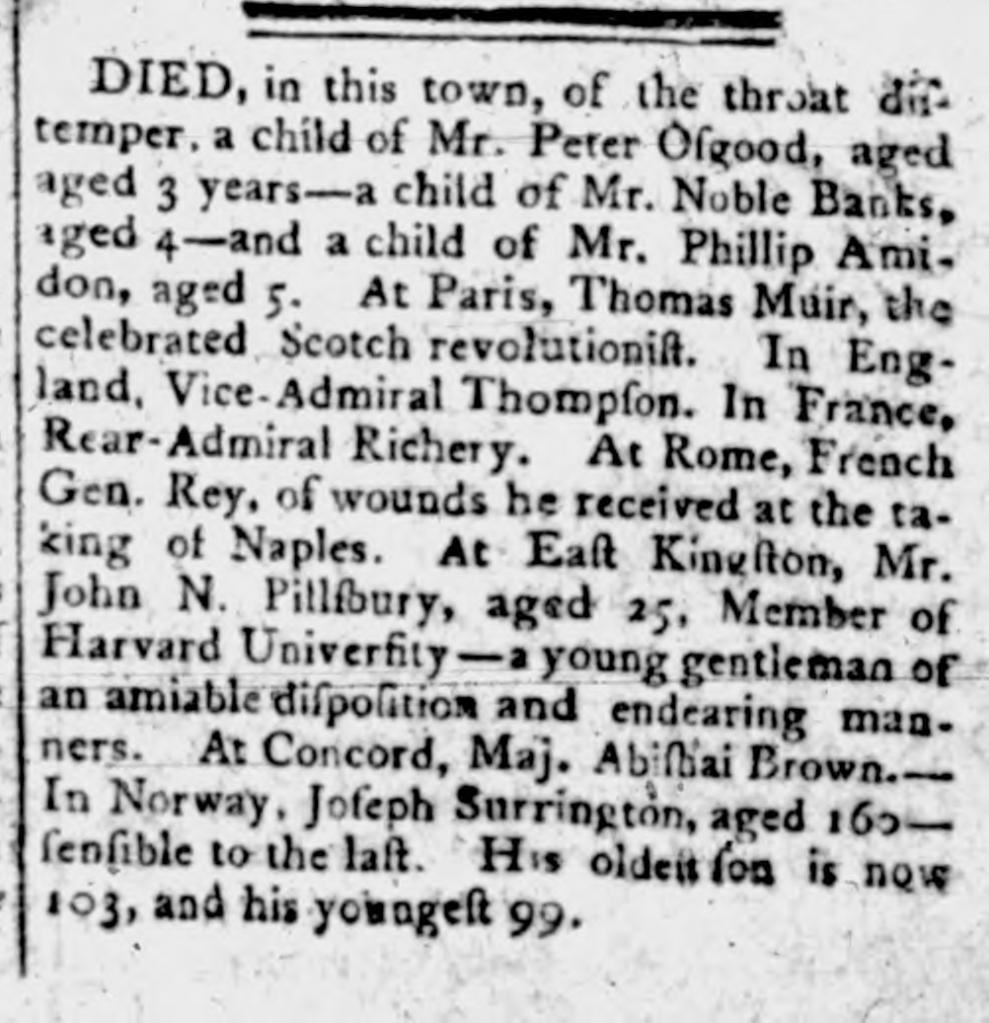
On May 11, 1799 it was reported that 3 young children died of ‘throat distemper’. The throat distemper epidemic in New England actually happened from 1735-1740, but clearly it ebbed and flowed until the vaccine was discovered. We now know this illness as diptheria, and thankfully, because of the vaccine it’s now quite rare. According to Wikipedia, the United States saw 57 cases between 1980 and 2004.
On Saturday April 20, 1799 it was reported that James Hanscum expired from hydrophobia. Hydrophobia today is known as rabies. According to the article, he was bitten and it had healed but a month or so later he became sick and died.
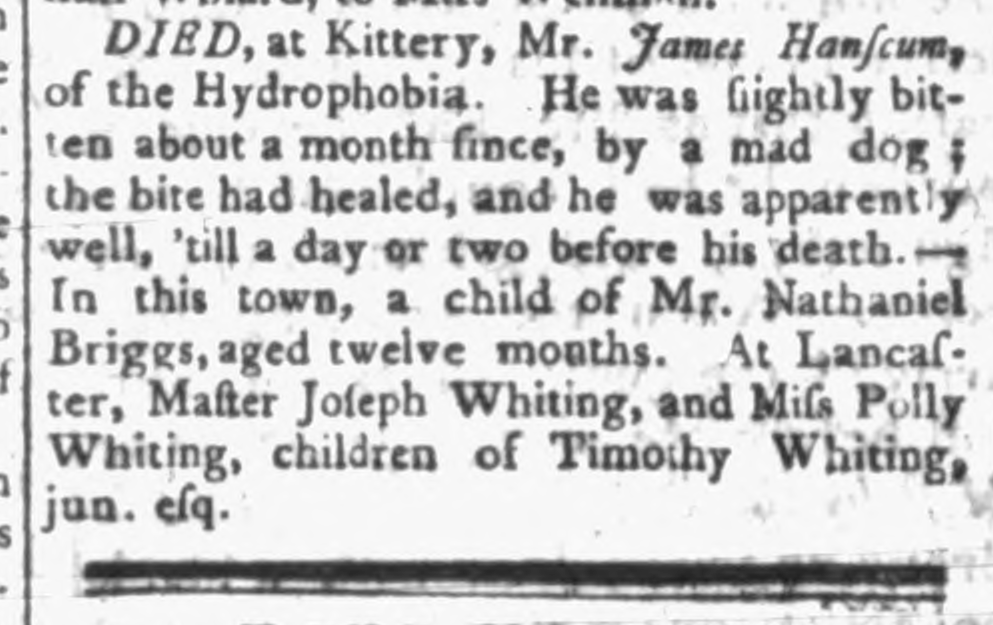
James Hanscum passed away from hydrophobia.
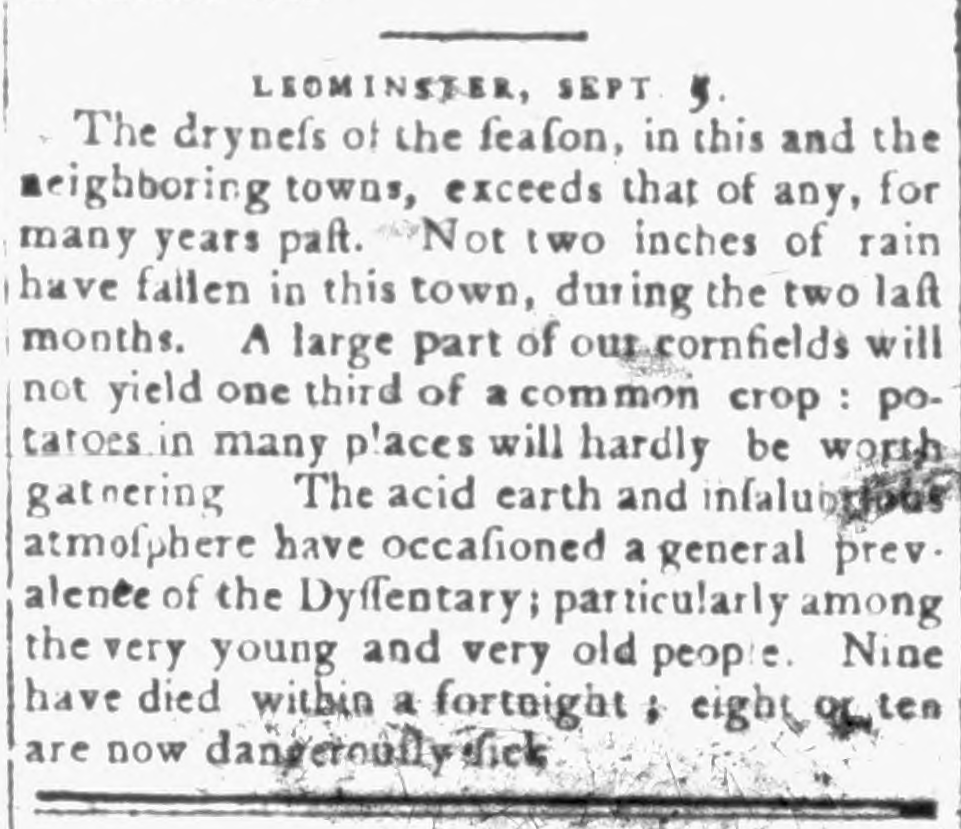
According to the Saturday September 7, 1799 edition, Leominster had been experiencing a dry season and thus caused several cases of dysentery. Within two weeks nine people had died of the illness with eight to ten more that were dangerously sick. If you are curious about dysentery and droughts, read this Yale University report called “Drought as a Climatic Driver of an Outbreak of Diarrhea in Tuvalu, South Pacific”
In the United State’s early days, scarlet fever was more commonly known as scarletina. Scarlet fever is caused by the same bacteria that causes strep throat. Today, scarlet fever is relatively rare. These days, it can be treated with antibiotics. In the early 1800s, bloodletting was the common way to treat scarlet fever. In fact, bloodletting was used to treat many ailments. In fact, George Washington tried this method right before he died. Read A Brief History of Bloodletting
In July of 1800, Polly Sikes, 15, of Walpole, died of scarlatina. Along with her death announcement was one of Sarah Griswald, 19, who died after a long sickness. Interestingly, two people died from falling trees. One was 52, the other 25.

Death announcements in The New Hampshire Sentinel 7/26/1800
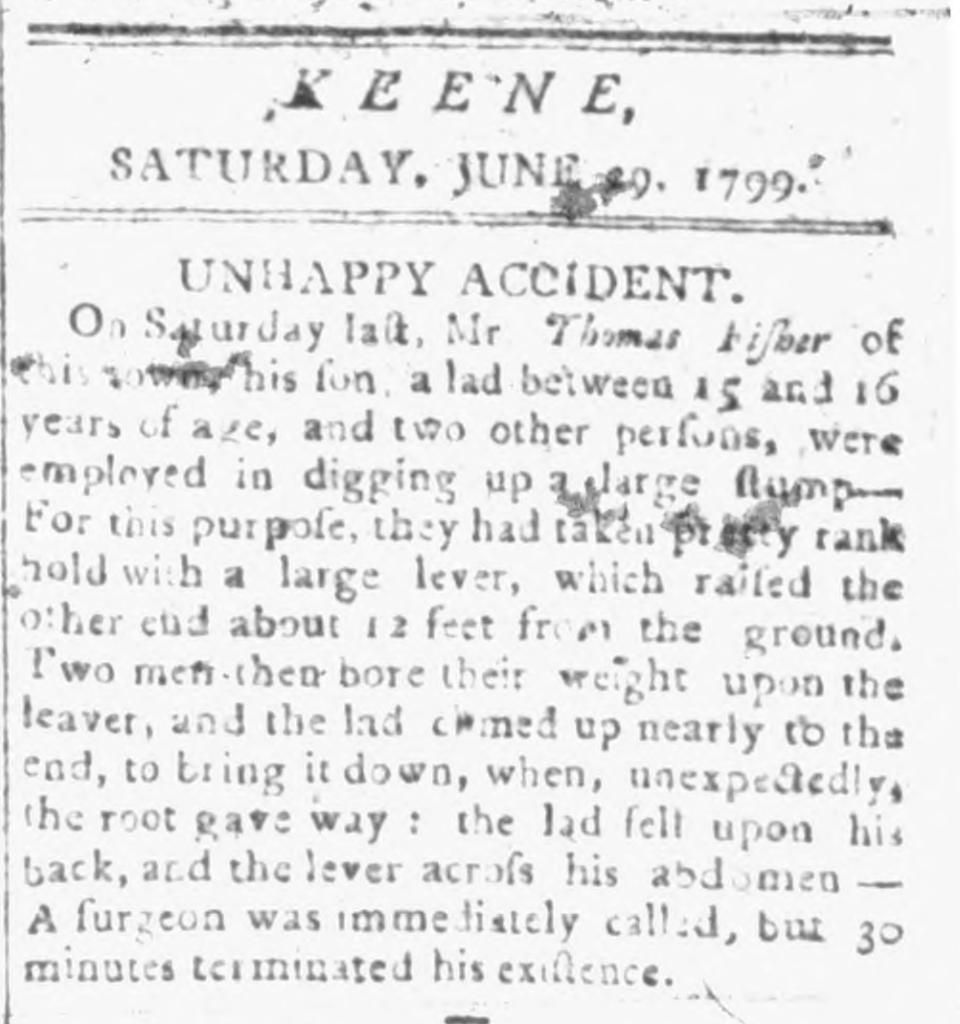
This leads me to discuss one last death that occurred on June 22, 1799. As reported in the New Hampshire Sentinel on Saturday, June 29, 1799, Mr. Thomas Fisher’s son who was around 15 years of age passed away from an “Unhappy Accident”. Mr. Fisher, his son, and two other gentlemen were digging up a large stump with a lever. The son climbed up and the root gave way. He fell and the lever landed on his abdomen and he took his last breath about 30 minutes later. After a bit of research, I found that his first name was Ziba. You can see Ziba Fisher’s death listed in the Vital Records of Keene, NH.
These articles were found on the NH History site keene.advantage-preservation.com. If you like my blog, please consider a donation. Thank you!
Make a one-time donation
Make a monthly donation
Make a yearly donation
Choose an amount
Or enter a custom amount
Your contribution is appreciated.
Your contribution is appreciated.
Your contribution is appreciated.
DonateDonate monthlyDonate yearly Bone Box